6-CHANNEL VISUALIZER
Realtime Visual Music
Six channels in. Six screens out.
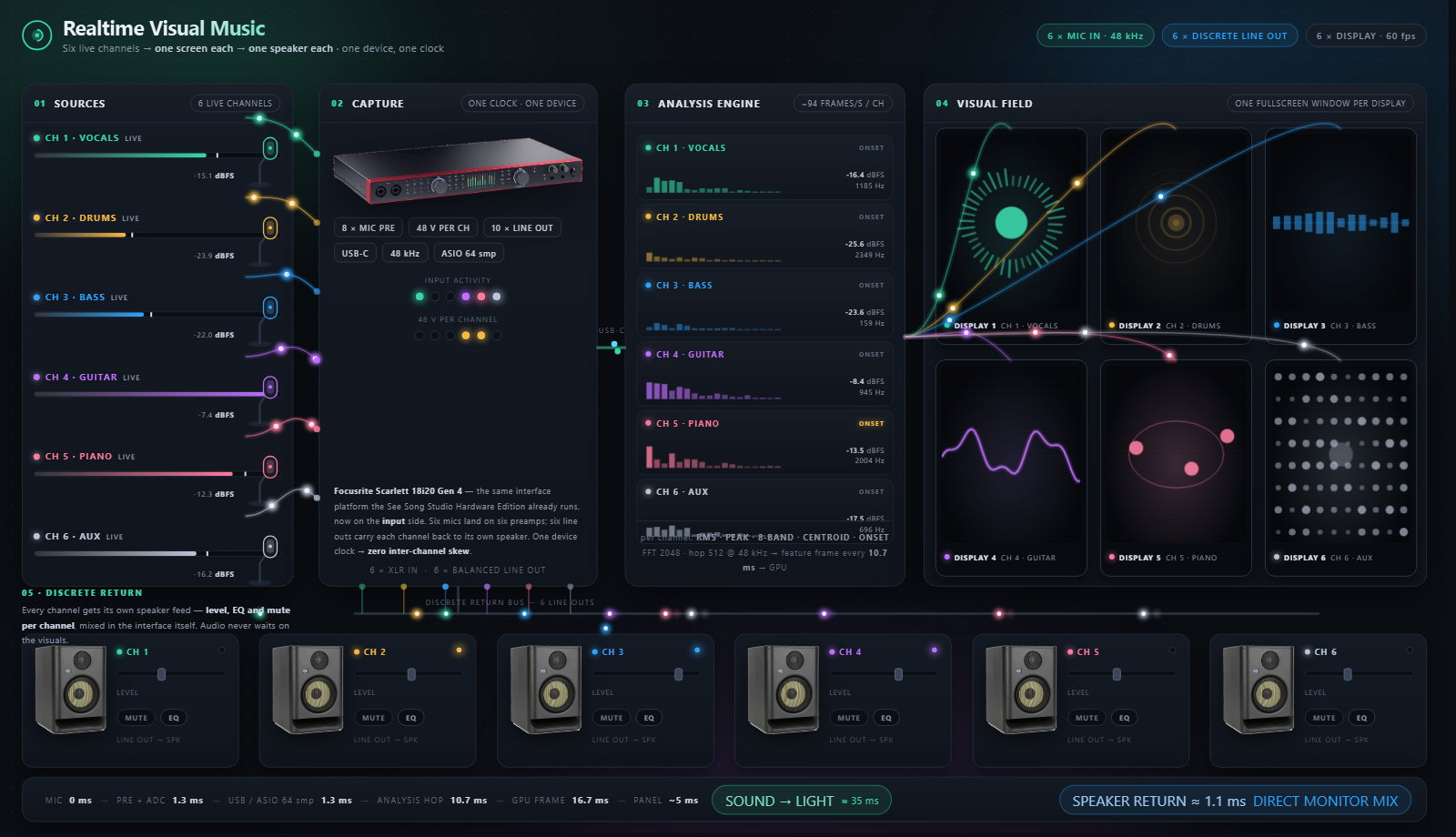
Six mics land on six preamps and a single multichannel ASIO stream at 48 kHz carries them all into one host — one device clock, zero inter-channel skew, ever. The audio path and the visual path split at the interface, and that split is the whole design: the sound never waits on the computer.
Per channel, the analysis engine measures DC, RMS and peak, then an FFT 2048 with a 512-sample hop lands an 8-band energy, spectral-centroid and onset-flux feature frame every 10.7 ms — about 94 reads per second per channel. Each of the six fullscreen windows is a pure function of those feature frames, so there is nothing to keep in sync and nothing to drift.
Sound-to-light comes in at roughly 35 ms, measured stage by stage — two display frames of total pipeline — and the speaker return is a hardware mix built inside the interface at about 1.1 ms, so the audio keeps playing even if the computer or the visuals hiccup. Fewer than six screens?
The channels fold onto whatever is there — three per screen on a two-monitor rig, six zones in one window on a single display. The rig does not depend on having six.
Six channels in, six screens out
six mics, six line outs, six 60 fps displays, one device clock
Capture on one clock
a single 48 kHz / 64-sample ASIO stream bypasses the OS mixer, zero inter-channel skew
Per-channel analysis ~94×/s
DC block, RMS/peak, FFT 2048 with a 512-sample hop: 8-band energy, spectral centroid and onset flux every 10.7 ms
One window per screen
each channel renders at 60 fps as a pure function of its feature frames, nothing to drift
Audio never waits on the computer
per-channel level, EQ and mute are built inside the interface at ≈1.1 ms
Sound → light in ≈35 ms
the full pipeline measured per stage: preamp 1.3 ms, USB 1.3 ms, analysis 10.7 ms, GPU frame 16.7 ms, panel ~5 ms
Folds to any screen count
three channels per screen on a two-monitor rig, six zones in one window on a single display